The company that introduced the fountain pen
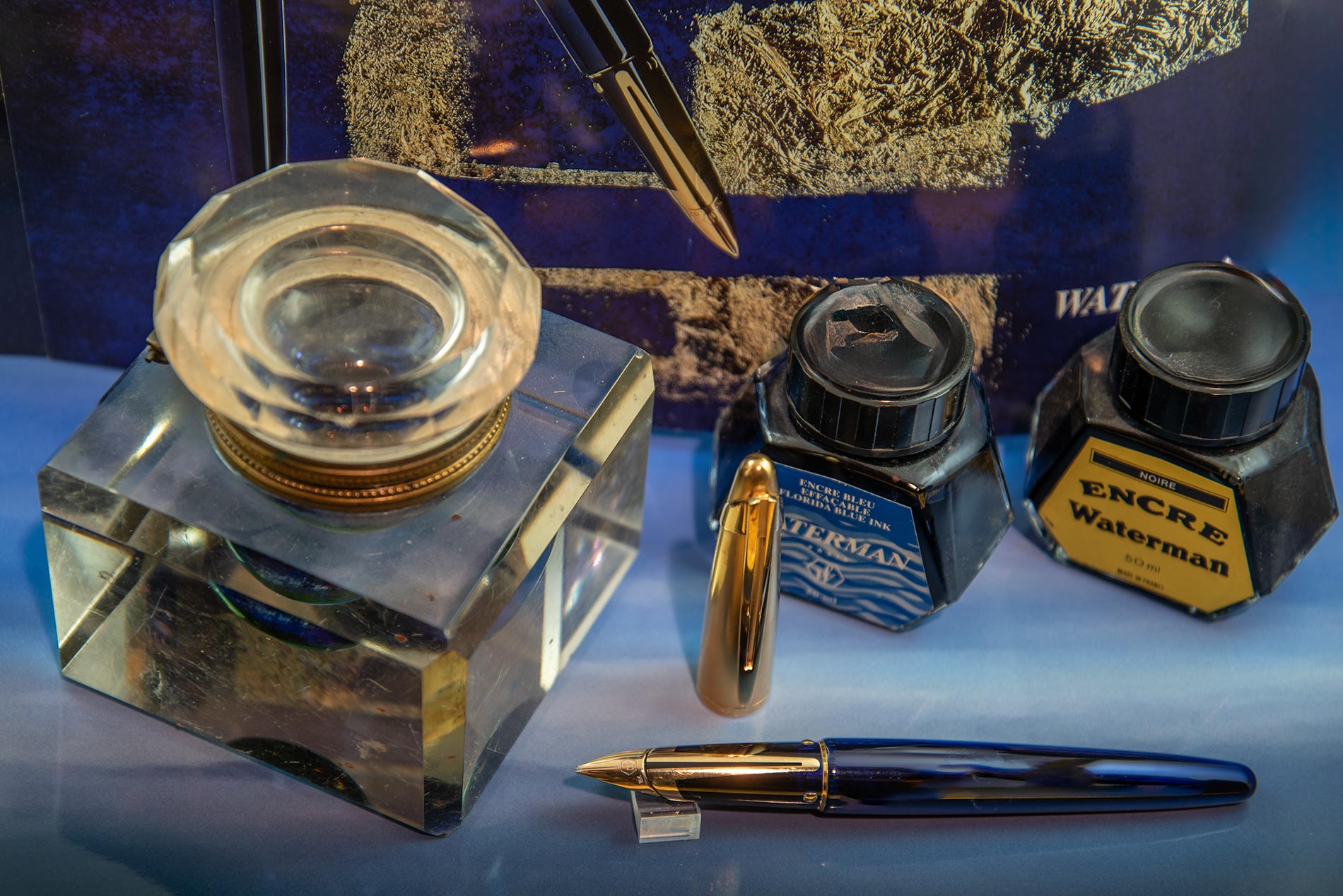
Since the 1970's I have been a pen enthusiast. My main passion is primarily with fountain pens. I always find myself drawn to my Waterman pens.
Why the pull to a Waterman pen? I always liked the way Waterman nibs glided across the paper. The pens had a balanced weight and size of the pen body was a good fit for my hand. Also, the pens had the feel of quality.
In the 1980s, as part of a trip of France, I arranged a visit of the Waterman factory in Saint Herblain, located just outside of the city of Nantes. I was luck to have the visit agreed to as at the time Waterman did not give tours to individuals. We were staying with friends just outside Nantes. I asked Chantelle to call the factory and confirm my visit, which she did, and I think they thought she was a member of my staff, the Glenn Marcus Corporation! We had quite the reception. They kept asking: "where was the rest of the group!"
I enjoyed walking through the factory, learning about the different stages of manufacturing. I gained an immediate appreciation for the amount of work that goes into making a quality fountain pen. Gone was the question as to why a fountain pen costs so much. There is a lot of handwork, with multiple parts, all which have to fit together just right. I was impressed with the individual pride the employees held about the quality of the finished pen.
Now much has changed. I was reading some of the information from the website of ouest-france.fr/pays-de-la-loire that was published over the past years. The Waterman factory is not the place today that it was when I had my visit. The 1,000 or so employees of the 1990s has been reduced to about 350 or so. But the 2021 article noted the good news that the part of the production of Waterman and Parker pens, that had been transferred to China, would be repatriated to be created in the Saint-Herblain factory for European and Middle Eastern markets. However, France is a small portion of the Waterman marketing and pens will continue to be produced in China.
The walk through started in the stamping section. Here large bands of brass are fed into machines that stamp out small circles. The circles of brass are then shaped into the pen parts by compressing the metal into various moulds. The process which compresses the brass gives the metal its strength. The stamping machines are set to produce each specific pen part.
Although the process is very automated, employees check for quality throughout the process. The final barrels and caps are placed in wire baskets which are labelled as to pen line and part. The parts are then cleaned by being immersed in a bath to remove the oils used in the stamping process.
Once the parts are cleaned, they go for cutting. Here the stamped-out barrels and caps are cut to the exact measurements of each particular pen. While much of the cutting is done automatically by machines, some pieces are cut by hand-operated machines. There is a fair amount of attention to detail. Employees set the programme for the specifics for each individual pen part.
All the manufacturing stages involve quality checks. Waterman employees are trained in a self-monitoring quality control checking process. I liked this approach. Quality is not something that someone else does, it is the responsibility of each individual employee. The employees I met demonstrated pride in their work and their concern for the quality of the finished product.
From the cutting section the metal pen pieces go to be polished. The barrels and caps are placed on spindles and pass under circular polishing brushes. All metal parts are polished and then cleaned again to remove oils used in the polishing process.
At this point, we were at a crossroad. The top-line pens are produced in a segment of the factory that involves a considerable amount of hand work. The other pen lines go to a section of the factory where the process is more automated.
I was especially interested in the manufacturing of the Man and Patrician series -- some of my favourite Waterman pens at the time. I followed the production process for top-line pens.
With the final cutting completed, the top-line pens require gold plating of various parts. Here, racks of pen parts are immersed in plating baths. Employees programme the machines that immerse the pen parts in the baths so that each part receives the right amount of gold plate.
The making of the nibs for the top-line fountain pens is a very manual process. Bands of gold pass through a machine that make an initial cut into the rough shape of the nib. These pieces are fed into a presser that compresses the metal. By compressing the metal it increases the strength of the metal. The nibs are given a tapered thickness which develops the "spring" of the nib. The nib piece then receive a final cut appropriate for the specific pen model. Engraving is added to the nib. The tip is then coated with a mixture of hard metals and the small ball at the tip of the nib is manually welded to the nib. The nib is then cut to create the forks. There is a final moulding and calibration of the tension of the forks. Yes, lots of manual detailed work to create a nib. When I took my tour, Waterman created their own gold nibs in the factory.
I have always been impressed with the smoothness of my Waterman nibs. I now know why! Employees test each nib for smoothness by trying the nib on a sheet of paper. Once the nibs pass this test they go through a final polishing process. The nibs and pens are assembled and then tested with ink for proper flow.
It was a complete factory, with Waterman producing all the individual parts for their pens. The plant has an extensive moulding section that produces the various non-metal pen parts for all lines of pens. They even mould their own ink cartridge bodies. In addition to the pens, Waterman produces their own ink at the factory and makes all the particular colours of ink by adding colours to a base ink.
At the end of the tour I have an even higher appreciation for my Waterman pens. I never realized how many people worked so hard to produce the pens that I cherish!
I thank my hosts--Patrick Hulot, Quality Department; and Christiane Pinguaud, Secretary to the Factory Manager for their assistance with the visit.
Postscipt: I now look back at this article and think how much the pen landscape has changed from the year I toured the Waterman factory. Waterman had gone through a number of owners. With each new owner, the company has revised its relative marketing plan. From what I have read the factory now produces the upper lines of both Waterman and Parker pens (Newell France Production, Newell owns both Parker and Waterman.) The more entry level pens which were when I toured the factory produced in a special section of the factory are now typically made off-shore.
A company's website makes a statement about the company. In March 2025, as was in 2025, if you select catalogue - don't be surprised if the 2021 catalogue is presented! the4 catalogue presents bottled ink (my favourite ink) but the website only lists cartridges and ball point refils. The wood stake is they do not even list Canada as a country withy retailers, as they pulled out of Canada in 2025.
Copyright © Glenn Marcus · All Rights Reserved · glennspens.com